
Carrie Fertig Biography
In third grade I began to make jewelry which I sold during recess out of an old suitcase. At 26 I started my own studio starting with a line of handmade jewelry. Jewelry evolved and shared company with housewares, Christmas ornaments and eventually a cathedral. While my work has predominantly been metal, there have been forays into wood, glass, and a large chunk of stone.
St. John the Divine in New York City is the largest gothic cathedral in the world. Since the outbreak of the second world war all work stopped on the building of it. (It’s not finished yet.) The central doorway of the West Front, the Portal of Paradise, was not a restoration, but new work with the blocks unusually in situ, and began in 1988 headed by Simon Verity. I worked on these statues the last two years of the project. I also made the bronze plaques for the TWA Flight 800 memorial inside the cathedral. I am largely self taught as a metalsmith. Over the course of twenty years I have had one week of general metals training with Chris Corriea, two weeks of casting, two weeks of etching with Linda Threadgill, and two workshops with Valentin Yotkov, who is probably the second best chaser and repousser in the world. (According to him!) In 2003 I moved to England and shortly thereafter I went on holiday to Scotland where I fell in love with Edinburgh (perhaps the kilts were an influence) and settled there. Since moving to the UK, my metal work has concentrated on Christmas ornaments. Perhaps it is the history here, but I find much to inspire me in regard to getting meaning back into the things that we decorate our trees with for Christmas. I studied glass at Edinburgh College of Art and spent all my holidays in Lauscha, Germany, learning flameworking glass technique. I exhibit, perform,and have taught internationally. I am a socially engaged interdisciplinary artist.
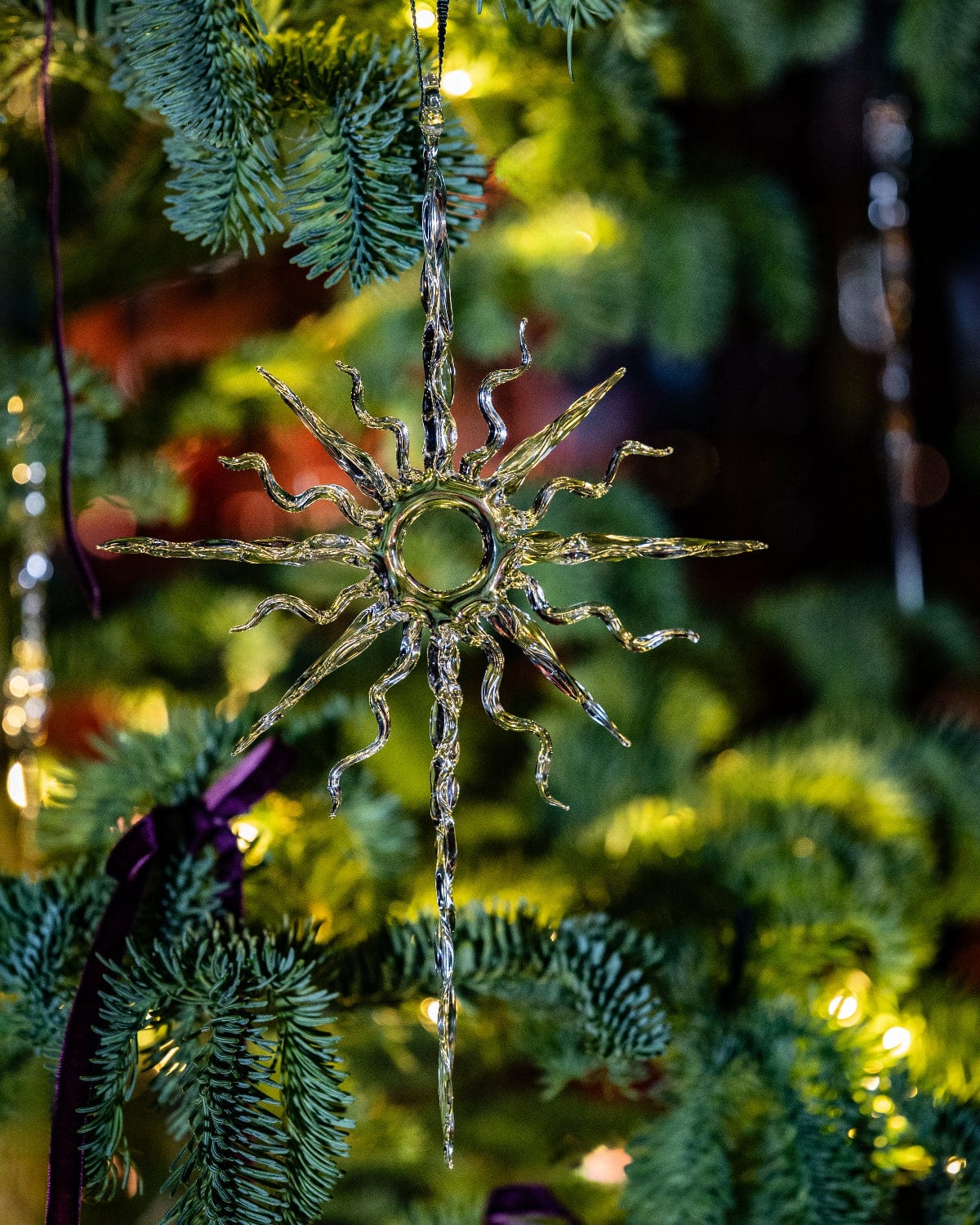
My glass ornaments and sculpture are flameworked glass, blown or solid sculpted, made from borosilicate glass. My metal Christmas ornaments are made with a range of techniques. The copper range of ornaments and tree toppers begin in one of two methods; the one-off pieces are cut with minute saw blades and a jewellers saw after piercing with a drill where necessary to get the sawblade in; or they are photo-etched, as this enables me to produce reasonably priced, but still hand wrought ornaments. Once the flat shape is achieved by either method, then the pieces are hand hammered onto both an anvil and a cut off tree trunk, the former giving lovely hammer marks, and the latter providing a soft surface for raising (adding dimension, curves and increasing the depth of the piece. Once the raising has been completed, then I use tiny pliers to add further depth manipulating tiny cut-out details, for example ears and the petal edges of the Tudor rose. The tree toppers then have copper tubes soldered on to their backs to accommodate the tree tip.